Functions in TfeTextView
TfeTextView functions are described in this section.
tfetextview.h
The header file tfetextview.h provides:
- The type of TfeTextView, which is
TFE_TYPE_TEXT_VIEW. - The expansion of
G_DECLARE_FINAL_TYPEincludes some useful macros. - Constants for the
open-responsesignal is defined.. - Public functions of
tfetextview.care declared.
Therefore, Any programs use TfeTextView needs to include
tfetextview.h.
@@@include tfetextview//tfetextview.h @@@
- 1,2,35: Thanks to these three lines, the following lines are
included only once. You can use
#pragma onceinstead of them. It is non-standard but widely used. - 4: Includes gtk4 header files. The header file
gtk4also has the same mechanism to avoid including it multiple times. - 6-7: These two lines define TfeTextView type, its class structure
and some useful macros.
TfeTextViewandTfeTextViewClassare declared as typedef of C structures.- You need to define a structure
_TfeTextViewlater. - The class structure
_TfeTextViewClassis defined here. You don’t need to define it by yourself. - Convenience functions
TFE_TEXT_VIEW ()for casting andTFE_IS_TEXT_VIEWfor type check are defined.
- 9-15: A definition of the value of the parameter of “open-response” signal.
- 17-33: Declarations of public functions on TfeTextView.
Instance creation Functions
A TfeTextView instance is created with tfe_text_view_new
or tfe_text_view_new_with_file.
GtkWidget *tfe_text_view_new (void);tfe_text_view_new just creates a new TfeTextView
instance and returns the pointer to the new instance.
GtkWidget *tfe_text_view_new_with_file (GFile *file);tfe_text_view_new_with_file is given a Gfile object as
an argument and it loads the file into the GtkTextBuffer instance, then
returns the pointer to the new instance. If an error occurs during the
creation process, NULL is returned.
Each function is defined as follows.
@@@include tfetextview/tfetextview.c tfe_text_view_new_with_file tfe_text_view_new @@@
- 23-25:
tfe_text_view_newfunction. Just returns the value from the functiong_object_newbut casts it to the pointer to GtkWidget. The functiong_object_newcreates any instances of its descendant class. The arguments are the type of the class, property list and NULL. Null is the end mark of the property list. TfeTextView “wrap-mode” property has GTK_WRAP_WORD_CHAR as the default value. - 1-21:
tfe_text_view_new_with_filefunction. - 3:
g_return_val_if_failis described in GLib API Reference – g_return_val_if_fail. And also GLib API Reference – Message Logging. It tests whether the argumentfileis a pointer to GFile. If it’s true, then the program goes on to the next line. If it’s false, then it returns NULL (the second argument) immediately. And at the same time it logs out the error message (usually the log is outputted to stderr or stdout). This function is used to check the programmer’s error. If an error occurs, the solution is usually to change the (caller) program and fix the bug. You need to distinguish programmer’s errors and runtime errors. You shouldn’t use this function to find runtime errors. - 10-11: If an error occurs when reading the file, then the function returns NULL.
- 13: Calls the function
tfe_text_view_new. The function creates TfeTextView instance and returns the pointer to the instance. If an error happens intfe_text_view_new, it returns NULL. - 14: Gets the pointer to GtkTextBuffer corresponds to
tv. The pointer is assigned totb - 15: Assigns the contents read from the file to GtkTextBuffer pointed
by
tb. - 16: Duplicates
fileand setstv->fileto point it. - 17: The function
gtk_text_buffer_set_modified (tb, FALSE)sets the modification flag oftbto FALSE. The modification flag indicates that the contents of the buffer has been modified. It is used when the contents are saved. If the modification flag is FALSE, it doesn’t need to save the contents. - 19: Frees the memories pointed by
contents. - 20: Returns
tv, which is a pointer to the newly created TfeTextView instance. If an error happens, NULL is returned.
Save related functions
Save and saveas functions write the contents in the GtkTextBuffer to a file.
void tfe_text_view_save (TfeTextView *tv)The function tfe_text_view_save writes the contents in
the GtkTextBuffer to a file specified by tv->file. If
tv->file is NULL, then it shows GtkFileChooserDialog and
prompts the user to choose a file to save. Then it saves the contents to
the file and sets tv->file to point the GFile instance
for the file.
void tfe_text_view_saveas (TfeTextView *tv)The function saveas uses GtkFileChooserDialog and
prompts the user to select a existed file or specify a new file to save.
Then, the function changes tv->file and save the
contents to the specified file. If an error occurs, it is shown to the
user through the message dialog. The error is managed only in the
TfeTextView and no information is notified to the caller.
save_file function
@@@include tfetextview/tfetextview.c save_file @@@
- The function
save_fileis called fromsaveas_dialog_responseandtfe_text_view_save. This function saves the contents of the buffer to the file given as an argument. If error happens, it displays an error message. So, a caller of this function don’t need to take care of errors. The class of this function isstatic. Therefore, only functions in this file (tfetextview.c) call this function. Such static functions usually don’t haveg_return_val_if_failfunction. - 10-11: Gets the text contents from the buffer.
- 12: The function
g_file_replace_contentswrites the contents to the file and returns the status (true = success/ false = fail). It has many parameters, but some of them are almost always given the same values.- GFile* file: GFile to which the contents are saved.
- const char* contents: contents to be saved. The string is owned by the caller.
- gsize length: the length of the contents
- const char* etag: entity tag. It is usually NULL.
- gboolean make_backup: true to make a backup if the file exists. false not to make it. the file will be overwritten.
- GFileCreateFlags flags: usually
G_FILE_CREATE_NONEis fine. - char** new_etag: new entity tag. It is usually NULL.
- GCancellable* cancellable: If a cancellable instance is set, the other thread can cancel this operation. it is usually NULL.
- GError** error: If error happens, GError will be set.
- 13,14: If no error happens, set the modified flag to be FALSE. This means that the buffer is not modified since it has been saved.
- 15-22: If it fails to save the contents, an error message will be displayed.
- 17-18: Creates a message dialog. The parameters are:
- GtkWindow* parent: transient parent window. This allows window managers to keep the dialog on top of the parent window, or center the dialog over the parent window. It is possible to give no parent window to the dialog. However, it is encouraged to give parents to dialogs.
- GtkDialogFlags flags: GTK_DIALOG_MODAL for modal dialog. A modal dialog is usually fine.
- GtkMessageType type: GTK_MESSAGE_ERROR for error message. Other options are GTK_MESSAGE_INFO, GTK_MESSAGE_WARNING and so on.
- GtkButtonsType buttons: GTK_BUTTON_OK is used most often. Other option is GTK_BUTTON_YES_NO, GTK_BUTTON_CANCEL and so on.
- const gchar* message_format: gchar is the same as char. This format is the same as printf. Arguments for the message format follow.
- 19: Connects the “response” signal to
gtk_window_destroy, so that the dialog disappears when the user clicks on the button. - 20: Shows the message dialog.
- 21: Frees
errwithg_error_freefunction. - 23: Frees
contents. - 24: Returns to the caller.
saveas_dialog_response function
@@@include tfetextview/tfetextview.c saveas_dialog_response @@@
- The function
saveas_dialog_responseis a signal handler for the “response” signal on GtkFileChooserDialog. This handler analyzes the response and determines whether to save the contents or not. - 7-25: If the response is
GTK_RESPONSE_ACCEPT, the user has clicked on theSavebutton and the contents will be saved. - 8: Gets the GFile
filefrom the GtkFileChooserDialog. - 9-10: If it doesn’t point GFile, a warning message will be output to the log. This is not expected.
- 11: Otherwise, it calls
save_fileto save the contents to the file. - 12-22: If
save_filehas successfully saved the contents, the following will be done.- If
tv->fileis GFile andfileis a different file, unreftv->file. - If
tv->fileis GFile andfilepoints the same file astv->file, nothing needs to do. Otherwise,tv->fileis set tofileand “change-file” signal is emitted.
- If
- 22, 24: Unref
file. - 26: destroys the file chooser dialog.
tfe_text_view_save function
@@@include tfetextview/tfetextview.c tfe_text_view_save @@@
- The function
tfe_text_view_savewrites the contents to thetv->filefile. It callstfe_text_view_saveasorsave_file. - 1-3: The function is public, i.e. it is open to the other objects.
So, it doesn’t have
staticclass. Public functions should check the parameter type withg_return_if_failfunction. Iftvis not a pointer to a TfeTextView instance, then it logs an error message and immediately returns. This function is similar tog_return_val_if_fail, but no value is returned becausetfe_text_view_savedoesn’t return a value (void). - 5-6: GtkTextBuffer
tband GtkWidget (GtkWindow)winare set. The functiongtk_widget_get_ancestor (widget, type)returns the first ancestor of the widget with type. The type is a GType. For example, the type of GtkWindow isGTK_TYPE_WINDOWand the one of TfeTextView isTFE_TYPE_TEXT_VIEW. Be careful. The parent-child relationship here is the one for widgets, not classes. The top level window may be a GtkApplicationWindow, but it depends on the application. Because TfeTextView is a library, it can’t determine the top level window type (GtkWindow or GtkApplicationWindow). GtkWindow is a parent class of GtkApplication window so it is more general. Therefore, TfeTextView takes GtkWindow as a top level window so that it can be used by any application. - 8-9: If the buffer hasn’t modified, it doesn’t need to be saved.
- 10-11: If
tv->fileis NULL, which means no file has given yet, it callstfe_text_view_saveasto prompt a user to select a file and save the contents. - 12-13: If
tv->filedoesn’t point GFile, an error message is logged out. It is not expected. - 14-15: Otherwise, it calls
save_fileto save the contents to the filetv->file.
tfe_text_view_saveas function
@@@include tfetextview/tfetextview.c tfe_text_view_saveas @@@
- The function
tfe_text_view_saveasshows GtkFileChooserDialog and prompts the user to choose a file and save the contents. - 1-3: Check the type of
tvbecause the caller may be other object. This function is public. - 6: GtkWidget
winis set to the top level window. - 8-11: Creates GtkFileChooserDialog. It has at least four parameters.
- const char* title: title of the dialog shown at the bar.
- GtkWindow* parent: transient parent window.
- GtkFileChooserAction action: action is one of
GTK_FILE_CHOOSER_ACTION_OPEN,GTK_FILE_CHOOSER_ACTION_SAVEandGTK_FILE_CHOOSER_ACTION_SELECT_FOLDER. When you want to save a file,GTK_FILE_CHOOSER_ACTION_SAVEis the action. - const char* first_button_text: the label text of the first button.
- type: response ID for the sirst button. response ID is one of the GtkReponseType. See GtkResponseType.
- followed by pairs of button text and response ID…
- NULL is put at the end of the list.
- The GtkFileChooserDialog will have the title “Save file”, transient
parent
win, save mode action, cancel and save button. - 12: connects the “response” signal and
saveas_dialog_responsehandler. - 13: Shows the dialog.
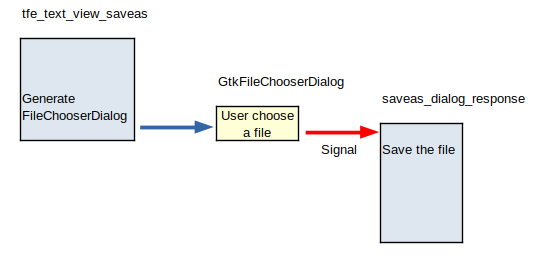
When you use GtkFileChooserDialog, you need to divide the program
into two parts. One is a function which creates GtkFileChooserDialog and
the other is a signal handler. The function just creates and shows
GtkFileChooserDialog. The rest is done by the handler. It gets Gfile
from GtkFileChooserDialog and saves the buffer to the file by calling
save_file.
Open related functions
Open function shows GtkFileChooserDialog to a user and prompts them to choose a file. Then it reads the file and puts the text into GtkTextBuffer.
void tfe_text_view_open (TfeTextView *tv, GtkWindow *win);The parameter win is the top-level window. It will be a
transient parent window of GtkFileChooserDialog when the dialog is
created.
This function may be called just after tv has been
created. In that case, tv has not been incorporated into
the widget hierarchy. Therefore it is impossible to get the top-level
window from tv. That’s why the function needs
win parameter.
This function is usually called when the buffer of tv is
empty. However, even if the buffer is not empty,
tfe_text_view_open doesn’t treat it as an error. If you
want to revert the buffer, calling this function is appropriate.
Open and read process is divided into two phases. One is showing GtkFileChooserDialog and the other is its response handler. The response handler gets the filename, reads the contents of the file and puts it into the GtkTextBuffer.
open_dialog_response function
@@@include tfetextview/tfetextview.c open_dialog_response @@@
- 2: The handler
open_dialog_responsehas three parameters.- GtkWidget *dialog: FileChooserDialog on which the “response” signal is emitted.
- gint response: response ID
- TfeTextView *tv: textview to put the contents to
- 10-11: If the response is not
GTK_RESPONSE_ACCEPT, the user has clicked on the “Cancel” button or close button on the header bar. Then, “open-response” signal is emitted. The parameter of the signal isTFE_OPEN_RESPONSE_CANCEL. - 12-14: Gets the pointer to the GFile by
gtk_file_chooser_get_file. If it doesn’t point GFile, maybe an error has occurred. It is not expected, though. Then it emits “open-response” signal with the parameterTFE_OPEN_RESPONSE_ERROR. - 15-22: If an error occurs when file reading, then it decreases the
reference count of the GFile, shows a message dialog to report the error
to the user and emits “open-response” signal with the parameter
TFE_OPEN_RESPONSE_ERROR. - 23-38: If the file has been successfully read, the following is
carried out. (It is not simple.)
- the text is inserted to GtkTextBuffer
- the temporary buffer
contentsis freed - modify-bit is set to FALSE
- open-response signal is emitted with
TFE_OPEN_REPONSE_SUCCESS - If the file are changed, change-file signal is emitted
- If
tv->fileisn’t NULL,g_object_unref(tv->file)is called tv->fileis assigned withfile
- 39: destroys GtkFileChooserDialog.
tfe_text_view_open function
@@@include tfetextview/tfetextview.c tfe_text_view_open @@@
- 3-4: Check the type of the arguments
tvandwin. Public functions always need to check the arguments. - 10-11: Creates GtkFileChooserDialog.
- The title is “Open file”.
- Transient parent window is the top-level window
win. - The action is open mode.
- The buttons are Cancel and Open.
- 12: connects the “response” signal and the handler.
- 13: Shows the dialog.
The whole process between the caller and TfeTextView is shown in the following diagram. It is really complicated. Because signal is the only way for GtkFileChooserDialog to communicate with others.
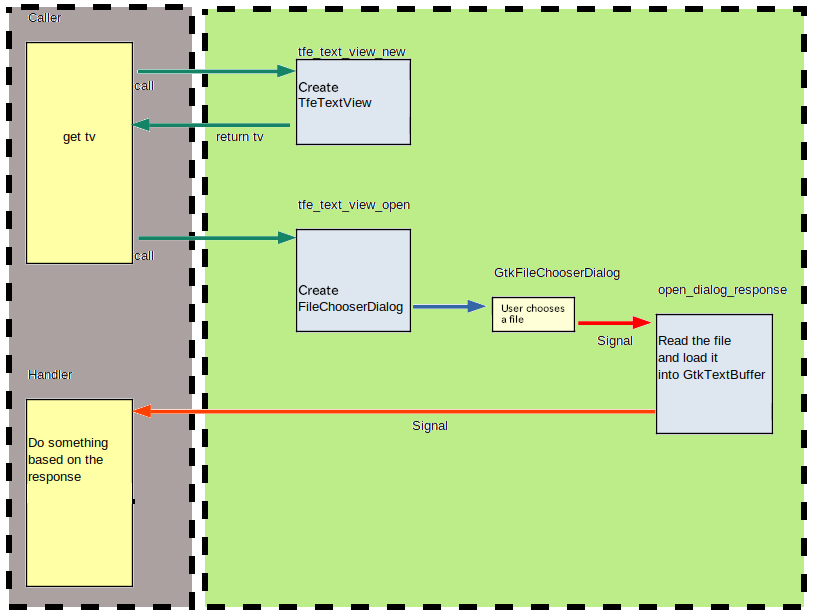
- A caller gets a pointer
tvto a TfeTextView instance by callingtfe_text_view_new. - The caller connects the handler (left bottom in the diagram) and the signal “open-response”.
- It calls
tfe_text_view_opento prompt the user to select a file from GtkFileChooserDialog. - The dialog emits a signal and it invokes the handler
open_dialog_response. - The handler reads the file and inserts the text into GtkTextBuffer and emits a signal to inform the status as a response code.
- The handler out of the TfeTextView receives the signal.
Getting GFile in TfeTextView
You can get the GFile in a TfeTextView instance with
tfe_text_view_get_file. It is very simple.
@@@include tfetextview/tfetextview.c tfe_text_view_get_file @@@
The important thing is to duplicate tv->file.
Otherwise, if the caller frees the GFile object,
tv->file is no more guaranteed to point the GFile.
Another reason to use g_file_dup is that GFile isn’t
thread-safe. If you use GFile in the different thread, the duplication
is necessary. See Gio API Reference –
g_file_dup.
The API document and source file of tfetextview.c
Refer API
document of TfeTextView. The markdown file is under the directory
src/tfetextview.
You can find all the TfeTextView source codes under src/tfetextview directories.